Tuesday, August 08, 2006

Towering Ambitions

Ole Scheeren of OMA is driving the world’s largest architectural project, Beijing's CCTV+TVCC

by Alex Pasternack


Important architects tend to look and sound as ostentatious as their designs, which is why you may not immediately recognize Ole Scheeren. The angular 35-year old German was sitting in a coffee shop in the Central Business District recently, wearing a shirt with an open collar, a pair of jeans, a day-old beard on his schoolboy face, and none of those self-consciously eccentric glasses by which architects are sometimes known. Discussing his latest project, his speech was unassuming, thoughtful, and curious; he even arrived early. He hardly seemed, in other words, like the lead designer behind the CCTV Tower, the hulking loop of a building that, two years from completion, has already become both Beijing’s controversial new icon and the world’s biggest architectural marvel.


“If you would preoccupy yourself with feeling so great about what you’re doing, there is an implicit loss of criticality vis a vis what you’re doing,” he says in his light, clean European accent about CCTV going to his head. “And in the case of this project it would be a fairly fatal to the momentum. It requires total attention at every point at time. There’s very little time to think about it.”

Nor does the project give Scheeren much use for the sort of rhetorical flourishes for which architects, like his famous Dutch mentor and co-architect on the project, Rem Koolhaas, are sometimes known. And when Scheeren does say things like “this may be the most complex building ever built,” he’s not kidding.

Since it was approved in an orgiastic moment of development in 2002, the 450,000 square-meter glass and steel China Central Television headquarters literally twists the conventional skyscraper into a gravity-defying three-dimensional trapezoid in the impossible style of M.C. Escher. Nearby sits a companion building, the public-oriented Television Cultural Center (TVCC), which resembles a cubist boot. They’re a feat of architectural gymnastics (and careful diplomacy) that has left many confused, worried, or downright disbelieving. One might just be just as incredulous about the architect’s age.

“Being 35, in a lot of professions, you’re a grandfather already, but in architecture you’re seen as being young,” he says. Raised by an architect-father, and harboring building aspirations early on, “in a way I have the feeling that I started quite early, so I don’t feel quite that young anymore.” But, how prepared could he be to manage a team that at one point exceeded 400 architects and engineers? When I marveled aloud that this project would be the biggest, in terms of scale, that he or OMA had even built (his last project was a triplet of Prada stores in New York, Los Angeles, and San Francisco), he replied with a slight grin: “Actually, it’s one of the largest buildings ever built.”

Scheeren isn't worried about his relative lack of experience. “First, you have to ask what type of experience is relevant to run a project like this. It’s a project that exceeds the scale of anything done so far, and so experience is not valid in the traditional sense,” he says, without a note of pretension. “And it takes an enormous energy that you can hardly generate in your 60s,” an age group that Koolhaas recently reached.

“The point is to say you don’t know how it works, and don’t know how the context works, and to develop a structure that allows change within the process.” It turns out that that sort of radical thinking informed the design all along, from its hastily-imagined loop to the lattice external steelwork that supports the building. But such uncertainty—and at such cost, with an initial reported budget of $700 million—didn’t sit well with either critics or the authorities. A year after a contract was signed, the government ordered a review of all new buildings, and (so rumor went) the television building was to be taken off the air. For one and a half years, the CCTV construction site sat untouched. When the cranes rose again, following a rigorous official review, the budget had reportedly grown to $1.2 billion. But Scheeren wasn't fazed.

“The thing is, we never stopped working on the project,” Scheeren says. Continuing work in offices in Beijing, Rotterdam and London not only helped to maintain the schedule, Scheeren maintains, but also preserved precious morale, which is hard-won in a profession so vulnerable to the kind of political shifts and opaque bureaucracies which are rife in China.

But Scheeren also acknowledges that such a daring design could not have been undertaken anywhere but in Beijing, with its racing-car economy and cosmopolitan aspirations. This is not to indicate that China is a “wild east,” a vertiginous playground for foreign architects to test-drive their imaginations, he says. “I find that repulsive.” On the contrary, China’s progressive architectural vision and ambitious plans have placed on the architect a particular burden and opportunity: nothing less than helping usher in a kind of revolution-through-design. “It’s not a condition you can take lightly,” he says of building in China. “It’s a chance to make yourself part of a progressive environment.”

To be sure, the CCTV project—with its radical shape, recreation areas named the “fun belt” and the “fun palace,” and a section specially designed for visitors—seems an unlikely undertaking for one of the world’s largest propaganda machines, and a government famous for concealment. This (disturbing) irony hasn’t gone lost on Scheeren. Indeed, he practically revels in it.

“[Building] CCTV was seen from the beginning as a tool for change from inside the company,” he says, alluding to a cadre of risk-taking “younger people leading CCTV, lying beneath the skin of the older generation,” who championed the design. When he talked about the building recently at an exhibition in its honor that he curated at the Courtyard Gallery and soon to move to New York’s Museum of Modern Art, Scheeren practically avoided discussing the design, focusing instead on what the building’s open layout might mean to the everyday Beijinger, and for a 21st century China. “It’s a change that exists beyond the realm of architecture. I’ve always been interested in that.”

Indeed, dramatic change and breadth have been the motif of Scheeren’s work as much as his life. It was an early introduction to the profession through his architect-father and his first commission at age 21 that initially burned him out. For a while, playing rock music seemed more appealing. “You’re so close to it, it’s uncomfortable,” he says of his architecture pedigree. Things changed when he heard a presentation by Rem Koolhaas, whose own interests beyond architecture (he had once been Holland’s most promising young screenwriter) reignited Scheeren’s interest. “I realized that someday I wanted to work with him.”

After butting heads with teachers at the design academy in his home town, the south-west German city of Karlsruhe (“They were impressed but not in a pleasant way…At the end of the year, all my models were destroyed with the excuse that they fell off the shelf”), Scheeren decided to continue his studies in London. On the first day of school however, he found himself driving to Rotterdam, where OMA’s main office is located, in a friend’s borrowed car. It mattered little that when he woke up at a local youth hostel, he found his car ransacked: he marched over to OMA with all that remained, the clothing on his back and his portfolio.

“In retrospect, it’s hard to figure out how it all happened,” he says as he stares at the table, slightly smiling. “Maybe I had the feeling that I had nothing else to lose.” Koolhaas threw Scheeren onto a project that seemed on the verge of failure, with two weeks until deadline. The 18­-hour days paid off, he says proudly. “It was the only competition oma had won in a year and a half.”

But the restless Scheeren left OMA almost as quickly as he had arrived, taking a graphic design gig in New York, and reenrolling at school in London. But he stayed in touch with his mentor-cum-colleague Koolhaas. When the designer Muccia Prada called on OMA to design some new boutiques in the U.S., Koolhaas called Scheeren. “I never wanted to go back to Rotterdam,” he says, “but the project was so intriguing.”

When OMA bid on the CCTV project in 2002 (declining an invitation to make a proposal for Ground Zero), Scheeren made his biggest shift yet, from designing clothing boutiques to constructing one of the largest buildings in the world.

Having relocated to Beijing that year, Scheeren discovered that the first challenge was figuring out how to explain the wacky design. The initial model for the building, which, cast in plaster, looked more like a deranged sculpture than a television headquarters, proved unimpressive to some of CCTV’s leadership. “It’s a very direct, literal culture and that’s an issue that you have to deal with when you enter the realm of conceptual issues,” Scheeren says. He and Koolhaas scrambled to build a more literal, transparent model, and weeks later a contract was signed.

Aside from not having enough time to study Chinese (“it’s the biggest frustration of being here… My plan is that before the building is finished. I need to get a whole step ahead”), Scheeren is still adapting to the process of constructing buildings in China, which “at such a breathtaking speed, cannot happen in a fully coherent matter.” But he hopes to inspire some change, too.

“I think part of the role of architects coming to build here is not only to bring a different sense of design but to try to step back and urge them,” planners, developers, clients and contractors, “to open up more lines of communication.” Scheeren says he aims for slower, careful consultations when proposing projects, like his successful bid for a new Beijing Books Building and a Prada “epicenter” store in Shanghai (When we met, Scheeren said OMA’s chances to renovate the stock exchange in Shenzhen were “promising.”)

Though the CCTV Tower’s exterior design work is essentially complete, and the first floors have started to peek above the scaffolding, Scheeren and his 20-person Beijing office have shifted to working on the building’s interior. And then there’s the job of still convincing people that the building is actually going to be built.

“Many people still don’t believe it’s going to happen,” Scheeren says, with some exasperation, but also a bit of delight. The truth is, neither can he.

“You think it can’t happen. And then you finally see the piles being driven into the ground, and the steel rising,” he says, with a faint smile. “These are the only moments that you believe that it is really happening.”


this article was published in an abridged version in that's Beijing magazine (tbjHome), August 2006

Tuesday, August 01, 2006

City Scene: Who Needs Friends When You Have Money?

that's Beijing, August 2006

A salesperson robotically waving a wand that distributed a light mist, another dispassionately demonstrating a spinning top to a couple of curious African men, two of a handful of customers, while a television showed a program about the Olympics. On display were jade sculptures, silky qipao, a paltry assortment of tea, and a selection of benign English-language paperbacks. All the typical tchotchkes of friendship – that is, diplomatic, state-sanctioned friendship: business as usual at the Beijing Friendship Store.

Just when things couldn’t look any more stereotypical, the ever-ebullient Mark Rowswell – known to television audiences as Dashan – strolled off the escalator and onto the second floor. Somehow it made sense: China’s most famous laowai shopping at Beijing’s most famous laowai institution.

Built in 1964, the Friendship Store catered exclusively to tourists and diplomats, who could find along its aisles some of the Western goods and souvenirs that were unavailable in other state-run shops. State media have announced that by the end of the year, the store will be torn down to make room for two office towers, a serviced apartment building and a new eight-floor department store. Dashan was undisturbed on hearing the news.

Developed in part by Macau-based casino impresario Stanley Ho, the new complex is supposed to be finished in 2009, at a price tag of around RMB 4 billion. That’s about RMB 4 billion more than the store made in 2005, when it took home a net profit of RMB 79,200; an improvement over a loss of more than RMB 3 million in 2004. The planned-economy, Soviet-styled relic – with its famous Soviet-style customer service – just hasn’t been able to keep up in the unfriendly free market of modern Beijing.

Didn’t the store at least have the market cornered when it came to friendship? China’s top foreigner let out a chuckle and delved into the history of “friendship.”

“In the ’60 and ‘70s, ‘friendship’ meant ‘preferential treatment’ or ‘cheap,’ and had the connotation of a kind of third world brotherhood,” he explains. “But ever since the late ‘70s and early ‘80s, as a foreigner in China you’d always avoid anything with the word friendship on it,” because it meant paying an inflated price.

Alex Pearson, a Beijinger since 1982, remembers when the Friendship Store was an oasis of convenience. “We could find things like milk, yogurt and cheese, and Walkmans, radios, Hi-Fis …”

Lynn Gan, Rowswell’s wife, remembers the store differently. As a Chinese person “you had to have some kind of connection to come in here,” she said of the days when the store required that customers have foreign passports and Foreign Exchange Certificates as currency.

A cheery young sales clerk acknowledged the store could use an upgrade, but with some regret in her voice. “It’s going to become stricter,” she said of the management.

Would the new Friendship Store at least be friendlier?

She thought about it for a moment. “It’ll probably be more expensive.” Alex Pasternack

City Scene: Water-less World

that's Beijing, August 2006

Beijing has invested billions of yuan in massive projects to increase and improve its water supplies, but with a new initiative to change how the public uses the wet stuff – from raising the prices of water to promoting cutting edge toilets – do we sense desperation?

The driest major city in the world keeps getting drier, with an annual reserve of about 300 cubic meters of water per person; an acute shortage is generally considered to be 1,000 cubic meters or less. 2006 marks the eighth consecutive year of drought in the North China Plain, the longest drought since the founding of the People’s Republic according to the State Environmental Protection Administration (SEPA). “It’s as bad as Israel,” says Ma Jun, the president of the Institute of Citizens and the Environment. “It’s hard to be optimistic.”

“They are moving in all directions now, including the right ones,” says Christoph Peisert, a conservation expert with the German Agency for Technical Cooperation, who advises the government on water management. “But there’s not yet enough public interest in reducing the waste of water.” Last month, Ma Weifang, an official with the city’s sustainable development promotion committee, said that based upon the city’s current water consumption and efficiency levels, Beijing could face one of the worst droughts in its history at the same time as hosting its “Green Olympics” unless citizens learn to curb water consumption and use recycled water more efficiently.

To encourage these steps, the Beijing government in May issued its tallest water orders yet: It has promised to investigate water usage at construction sites, golf courses and saunas, imposing fines of up to RMB 10,000 if necessary. There’s also a mandate to install water-saving faucets in Beijing’s households. Recycling water is another strong focus, especially at car washes. While one car wash tbj visited was already using recycled water, no worker, or any other Beijing residents we’ve surveyed had heard about the recent water-saving campaign. Ma says, “At the moment, when they open the tap, they don’t realize what the effects are.”

While water consumption has reached a tipping point, Ma points out that the government’s conservation efforts can only do so much to ease the city’s shortage. Diminished ground water, for instance – which has caused Beijing to sink 10cm per year, reportedly threatening the stability of the new, heavy Olympic venues – can only be countered by improved irrigation and continued rainmaking, says Wen Bo, a local environmentalist. “Right now the government seems to have no way out.”

Replenishing the city’s water resources will require an even greater effort. The government recently announced plans to divert water from a Yangtze River tributary, which lies 1,200 km away from Beijing and whose polluted waters are an environmental concern. “I don’t see so many problems with the idea,” says Peisert, with a tone of resignation. In any case, it’s clear that further efforts need to be made to address both China’s ongoing environmental problems and the capital’s chronic water shortage – never before has a new water efficient toilet sounded so good. Alex Pasternack


Saturday, June 24, 2006

On the Road Again

From TIME asia Magazine, June 26, 2006 Vol. 167, No. 25

Ma Jian envisioned Tibet as Nirvana. The book he wrote after his journey offers a darker vision

In 1985, writes Ma Jian, he headed from Beijing to Tibet hoping to "work out what I should be doing with my life." Ma, like so many discontented romantics, envisioned the Himalayan land as a spiritual refuge from the modern world. But it was just a dream. What he discovered instead was a place whose heart had been ripped out. The few temples that remained after years of cultural and political purges by the Chinese government were guarded by soldiers and littered with slogans instructing allegiance to the Communist Party. The Dalai Lama had been exiled for more than three decades, and those who had stayed behind seemed consigned to a ruined fate.

In an afterword to Stick Out Your Tongue, a newly translated collection of short stories he wrote following his three-year journey to Tibet and other far-flung parts of China, Ma says he returned home more confused than before, feeling "as pathetic as a patient who sticks his tongue out and begs his doctor to diagnose what's wrong with him."

The diagnosis from Chinese officials, when Ma's book was released in 1987, was that his treatment of Tibet was "filthy and shameful" and had "nothing to do with reality." Every copy was ordered to be destroyed. But the collection quickly became a hit among the samizdat set; some enterprising black marketeers even copied it out by hand. Ma, who had once worked as a government propagandist, thus found himself forced into hiding. After stints in Hong Kong and Germany—with the occasional secret return to Beijing—he ended up in London, where he wrote a superb memoir, Red Dust, which appeared in translation in 2002. Where that narrative bounces along China's dusty roads and industrial backwaters like a better, eastern On the Road, the five short stories in Stick Out Your Tongue paint a more meditative portrait of a land that barely seems to move at all.

That's not to say the book isn't moving. In cool, spare prose, Ma powerfully conveys the double dislocation at the heart of his stories: a people estranged from their own home are described in four of these tales by the same Ma-like narrator, a dissident writer whose own life has been uprooted, too—not only by cultural crackdowns but by a string of failed loves. A Han Chinese in a land where the Han are despised, he has abandoned any fantasies about Tibet's peaceful locals: instead of sticking out their tongues—a customary greeting in Tibet—they throw stones at him. The glistening lakes and wide plateaus of central Tibet—where we find the narrator at the start of the hypnotic opening story—offer no solace either. Potentially sublime rustic experiences are tainted by brackish water or the stench of manure and animal hides. The narrator's hunt for enlightenment has already ended, and the traditional Buddhist sky burial of a young woman beaten to death by an abusive father is little more than an exotic photo-op. Just as the ritual of dismemberment ends, when "every piece of her had vanished from the site," the emotionally distant narrator remembers his appointment to go fishing with the woman's former lover.

The mistreatment of women by men is a common theme in all five of these stories. Beneath Tibet's enchanting surface, suggests Ma, lies the reality that its women are routinely forced into marriage, sex, prostitution and drugs. Yet Ma's bleak descriptions of their lives are not without a dreamy—though somewhat perverse—sense of redemption. A feisty, unfaithful wife burns and withers on a bronze stupa that her husband has built, only to be rolled up by her lover and devotedly draped on his wall. The final story—the tale of a young female monk forced by her elders through abusive rituals of spiritual enlightenment—ends the book as it began, with a beleaguered corpse that again seems to disappear, magically, into the scenery. This time, however, the woman isn't destroyed but transmuted like a bodhisattva, her body transparent: "A fish that had somehow gnawed its way into her corpse was swimming back and forth through her intestines." The narrator, who buys the woman's skull as a souvenir and hopes to sell it to finance his travels, writes her story "in the hopes that I can start to forget it," but the memory will not disappear.

Nor will the impression left by Ma's book, with its captivating blend of despair and hope, violence and dark humor, death and regeneration. In Ma's ambivalent portrayal, Tibet is as uneasy a place to live as it is to describe, and Tibetans possess a nuanced humanity often denied them—on the one hand by the idealized fancies of the Western imagination, and on the other by the Chinese government's oppression. The tongue of the book's title, then, is not only a reference to the traditional Tibetan greeting, but a complex symbol of ridicule and illness and vulnerability—and an invitation to see inside Tibet's dark mouth some precious signs of life.

Tuesday, June 13, 2006

Russian Doll

It's an old story: Wide-eyed nine-year old Jewish girl flees Russia to the shores of New York with her parents, who barely make ends meet while she passes her time exploring their Bronx neighborhood, the old Tin Pan Alley, and the piano keys — a remnant from years of practice in the old country and exposure to the classics (Chopin but also Pushkin). Soon, the setting becomes a downtown Manhattan nightclub, and she's stringing ragtime ballads, jazz standards, folk renditions, energy and vaudevillian pizzazz across the keys. Sheer talent plus a twist of fate would attract the attention of a snazzy producer and a wealthy band of patrons and ta da: Our heroine enters a world of minor celebrity nearly as surprising and strange as her musical narratives.

"We stopped at this truck stop in Colorado, and I'm in the fucking Subway, and there was a girl there getting a sandwich," Regina Spektor recounts a few weeks ago, using the f-word in the most excited, innocent way possible. "I saw her staring and she saw me and I thought about going up to her, but I thought maybe she was just staring, you know, didn't know who I was. Well. I got on MySpace today and someone wrote ‘I love your music and I smiled at you in the Subway.' I mean, wow."

Regina Spektor is running into fans in the strangest places; she's playing sell-out shows in the English countryside; she's getting written about on a hundred message boards and websites; she's on the phone from a hotel room at her latest tour stop, San Francisco. She also has a new album on a major label, Begin to Hope, a follow-up to 2004's Soviet Kitsch. It was a rough version of the latter that first pricked up the ears of the Strokes, who invited her on tour with them, and their producer, who recorded Kitsch. Almost three years later, and 17 years after fleeing Moscow, wow is still very much the theme. When on stage, perched on the edge of her stool, playing with her hands, chatting, the 26-year-old SUNY Purchase graduate still seems amazed, impressed, perplexed by it all, as if she's still learning something big from the crowds fawning over her.

"I can't imagine that kind of devotion, it's really beautiful," she says of the dedication which pushed fans across multiple states to see her play in Colorado in early May. "I played a show in Scotland where kids said they flew from Australia. In Bristol, people had come from Berlin," she says. The curly-haired Russian Jew from the Bronx with real estate on MySpace is trying to figure out where she is, and why people would bother coming that far. "I don't even know how to drive."

When she gets behind the keyboard however, Spektor could hardly sound more in control. From her measured debut, 11:11 through the more fanciful Songs and through the rich Kitsch, Spektor's fingers have learned to dance in jazz and pop and blues rhythms — occasionally parting ways to handle a drumstick on the nearest chair — with a precision matched by a voice that soars and halts aspirated, speaks in tongues and Russian and French and New Yawk accents, raps and, when a chair isn't available, carries the percussion too, beatbox style. On "Twenty Years of Snow," a new song that imitates a Polish mazurka, Spektor's plaintive minor chord progressions twinkle rapidly beneath a voice that ranges from fragile to breathy to speak-y before rolling into a rap that beckons a bop interlude before the recapitulation, where she stutters it all to a close. Such idiosyncratic stylings have earned her the fad label "anti-folk," along with comparisons to Tori, Bjork, Norah, Fiona, Ani and Joni. While perhaps flattering, these names don't do much more justice to Spektor's style than, say, likening her to Ronnie Spector. "Associations are associations," she shrugs, "but I definitely feel like my songs are my songs."


Whereas the adventurous vocal experiments of Soviet Kitsch could sometimes border on preciousness, Spektor's verbal tics on Hope — grunts, breaths, word-bendings and so on — become neater devices for her four-minute fables. The addition of electric guitar courtesy of The Strokes' Nick Valensi and the machinery of producer David Kahne even uncover a new, upbeat poppiness ("Fidelity," "Better," "Hotel Song"), while making room for even more improvisational tricks (see the Billie Holiday tribute "Lady" and the funky admonition "Edit"). Spektor recalls her reaction to first hearing a finished Hope: "I was like, ‘I love you, record." While she only had two weeks to record Soviet Kitsch, Spektor had a leisurely two months for her latest. "It's the first time in my life where I'm so excited that I want people to hear it, where I'm not giving a record to people with a disclaimer that it's not what I wanted it to be. I made it how I wanted to make it."

When asked about what inspired the record, Spektor characteristically points to nothing smaller than the world. "It's so diverse, it's a dream for anybody documenting anything. It's here! The world, write it down!" Her reluctance to talk shop is less a sign of coyness than honesty. "You know — a lot of it is imagination." And this is what most makes the record Spektor's: as usual, each of her songs is a character study in which love is cradled by the tragic knowledge that it can't last. The effects differ, as seen in the heartbroken biblical riff "Samson" and the exhilarating Joni Mitchell-flavored ballad "On the Radio": "This is how it works / you're young until you're not / you love until you don't… you hope it don't get hard / but even if it does, you just do it all again." Her large revelations writ small are sung with the same naïve wonder and confusion and graciousness she shows before her audiences — and which her rapt audiences in turn often show before her.

From a distance, the paradoxical feelings of her song-stories appear as echoes of lost nights, secret loves, and, inevitably, of her own complicated bond with the motherland. Mention returning to Russia, and Spektor sighs. "It's actually really complicated. I haven't figured any of that out. I definitely want to go back but haven't figured out when, or how. It's intense." When her family fled Russia, they were, as Jews, legally considered aliens within their own home. "I definitely love the culture, the people. But it's also very anti-Semitic, lawless, harsh. It's a place where I don't really feel like it's my home at all." Her first lyrics in Russian come in the album's most haunting ballad "Après Moi," where she quotes the poet Boris Pasternak: "February. To take ink and weep, / To write, sob your heart out, sing."

Spektor acknowledges the influence of another Russian literary genius, the tragic comedian Anton Chekhov — but not because of the dramas for which he's famous. "In the plays, he gets too rambly or too philosophical or something, which ends up pushing you out, and reminds you you're a reader or an audience member." It's an impression that hasn't gone lost on her own work. To her, his short stories are more compelling. "They're amazing because they're completely all encompassing. He takes you within them."

Begin to Hope is out on Sire Records on Jun. 13.

This story was published in Paper on June 13, 2006.

Thursday, June 01, 2006

City Scene: Sizing Up our Newest Sibling

that's Beijing, June 2006

Eager to make friends with the rest of the world in advance of the 2008 Olympic Games, Beijing’s vice mayor Sun Anmin jetted down to New Zealand last month to toss another municipality into its pile of “sister” cities, which already includes Madrid, Athens, Budapest, Bucharest, Havana, Manila, and even Tokyo. Though Beijing treated Wellington to the longest Chinese New Year fireworks display the Kiwi city had ever seen two years ago, no such large public events have yet been scheduled in Beijing to celebrate its link with the Kiwis. For now, the cities are relying instead on what Chinese state media calls “very strong” cultural, economic and political ties. Which consists of? “Well, for one, there’s the obvious connection – they’re both capitals,” says Grahame Morton, the first secretary at the New Zealand embassy. “Also, Wellington is a cultural center; and Beijing would like to think of itself as a cultural center in China.” It’s also worth mentioning that New Zealand’s famed kiwi fruit – one of the country’s biggest exports – is a native fruit of China, known as “mihou tao” (monkey’s peach) or Chinese gooseberry. If that’s not enough for you, here are some pointers to guide you through Beijing’s latest international sisterhood: Alex Pasternack

Wellington

Large public gathering
Watching the Wellington Hurricanes rout other rugby teams

Population
163,824

Current large-scale Municipal Project
The renovation of the Queens Wharf Events Center, adding 538 additional seats

Epic similarity
Home to Lord of the Rings director Peter Jackson, it was the main construction sit
for “Middle Earth.”

Place to find Beijingers
Haining Street

Outdoor athletics
Mountain biking on beautiful Mt. Victoria

Hometown hero known for violent outbursts
Wellington-born Russell Crowe

Weather
Strong winds blowing in from the gorgeous Cook Strait

Planning
At the center of Wellington’s ten-year plan is the “proposal to improve the region’s passenger transport system through new and refurbished trains and better bus services after 20 years of under-investment in this service.”

Beijing

Large public gathering
Watching the Beijing sandstorms rout badminton players

Population
163,824 times 87

Current large-scale municipal project
The construction of the National Stadium, or “Bird’s Nest,” which will contain 91,000 seats

Epic similarity
Now extending to the Sixth Ring Road, it’s the main construction site for “The Middle Kingdom”

Place to find Kiwis
The New Zealand Embassy

Outdoor athletics
Combat biking on, um, scenic Guloudong Dajie

Hometown hero known for violent outbursts
Beijing-born Jet Li

Weather
Strong winds blowing in from the Gobi Desert

Planning
Country’s five-year plan calls for “comprehensively strengthening economic, political and cultural construction, and the development of a harmonious society.”

City Scene: How to Repel the Sand

that's Beijing, June 2006

In the old days, village officials in China’s arid north would pray to the gods for rain. These days, when rainfall is badly needed to end droughts – or, increasingly, to clean up the city in advance of Beijing’s “Green Olympics” – the government doesn’t need to offer sacrifices to the heavens: it shoots chemicals at them with anti-aircraft cannons.

While China has been using rainmaking technology since the 1980s to stem droughts, the worst rash of sandstorms to hit Beijing in a decade has given officials new cause for aiming at the skies: giving the city a good rinse. After the roughest of last month’s sand attacks dumped 330,000 tons of sand on the city, the government responded by launching seven rocket shells and burning 163 pieces of “cigarette-like sticks” containing silver iodide. And voila! “The heaviest rainfall in Beijing this spring,” reported Xinhua.

While the effects of rainmaking on local ecosystems and health still remain unknown, there’s something disconcerting about forced rainfall (and it’s not just because cleaning the city apparently must involve chemical apparatus suggestive of a cigarette). “It’s a passive solution, it’s not a solution at all,” says Wen Bo, the local representative for the San Francisco-based group Pacific Environment. Like the “green wall” of trees currently being built to shield Beijing from sand, Wen says rainmaking is at best a quick fix to the sandstorms, which magnify the health dangers of the city’s already heavy smog. Beach weather in Beijing would be better addressed, Wen says, by local governments in nearby Hebei and Inner Mongolia making greater efforts to improve irrigation and vegetation practices and replanting trees.

Complicating the matter, as two recent government studies demonstrate, is disagreement over the cause of sandstorms. One study blames traditional spring ploughing techniques, which loosen topsoil prior to planting, while another identifies the routes that such storms take to reach Beijing, pinpointing the origin not in Chinese farmlands but in the deserts of Mongolia. Whatever the causes may be, Wen worries that rainmaking in Beijing threatens to “wash away not just the dirt, but people’s memory” of the actual problem – a case of saving face, but not necessarily the environment. Alex Pasternack

City Scene: Quincy’s Olympic Theme

that's Beijing, July 2006

When Quincy Jones came to town in late May – to announce, according to a press release, that he would “write songs for the Beijing Olympic Games,” tbj naturally had a hundred questions to ask the 71-time Grammy Award nominee. Unfortunately, the press conference answered few of them. For instance, will his song actually be used?
The organizers are running an open competition for Olympic theme music that has just entered its fourth round and will continue until 2008. This is not unusual – while every Games employs the original Olympics theme song, “Bugler’s Dream,” a fanfare written in the 1950s by French composer Leo Arnaud, each host city traditionally chooses another piece of music to mark its turn.

What was unusual was the lack of consensus about Jones’ involvement. Before they began their press conference, Jones, the executive vice-president of Beijing Organizing Committee for the Games of the XXIX Olympiad (BOCOG), Jiang Xiaoyu, and some advisors held a planning meeting in a side room, during which Jiang seemed to say that, once finished, Jones’ song would be thrown in with the work of the contest winners for a final assessment.

The misunderstanding didn’t stop there. Jones underscored that instead of a song, he’d be working on theme music. “Do you know the words to Star Wars?” he asked, then da-da-da-daa-dah-ed the famous theme by John Williams (an erstwhile Olympics theme composer himself). “You catch my drift? Theme music, it doesn’t have words.”

Regardless of the end result, Jones, who was encouraged to participate by his pal Jackie Chan, said that he would not accept money for his piece. And while he hasn’t started writing it yet, he imagines his theme would be a “global gumbo,” incorporating pop music, Western themes, and of course, traditional Chinese stuff.

“I love that instrument, the one with the strings,” he said pantomiming the guzheng, or zither. But that certainly wasn’t all the impresario loved about China, which he considers “awesome,” as he told the room of reporters.

“I’ve several times considered selling my home in California and staying here,” said Jones. “Between the food, and the culture, and the beautiful people – the beautiful ladies, incredible ladies, the most beautiful, beautiful women I’ve ever seen in my life, whaaaaow! Oh, good God. I don’t know how you’re going to translate that.” Alex Pasternack

Saturday, March 25, 2006

Review: Jel / Soft Money (Anticon)

The Sunday South China Morning Post, March 25, 2006

“Don’t buy this product, you don’t need it,” is a curious way to start rapping on your solo debut album. As Soft Money opens with To Buy a Car, Jel, nee Jeffrey Logan, is soberly imagining the click-y, breakbeat advertising jingle he’d write for a fleet of “street legal war vehicles.” But he’s also winking at the doting avant garde hip hop heads who just purchased—or more likely downloaded—his album.

The Chicago-born producer/MC doesn’t need such slogans to prove his anti-corporate mettle. As one of the founding members of hip hop’s best known underground collective, the Oakland, Calif.-based Anticon, he shaped the intricate musical bedrock for the lyrical acrobatics of groups like Themselves and Deep Puddle Dynamics. Fortunately, after the early proselytizing on that first track, Jel jumps off his soap box to grab a drink and slide back behind his old samplers to kick off this chill-out session.

What pretensions he may betray in his self-righteous lyrics—on a later track the war on terror becomes his easy target—he often abandons in an unusually accessible hip hop orchestration. The quick beat changes, strange syncopations, blurred samples and sheer noise that have lately become the heavy grist of “nerd rap” millers like Prefuse 73 are all but absent; in their place are spacious beats, cinematic cellos, twinkling Rhodes pianos and processed vocal snatches that make tracks like No Solution and Nice Last sound like the soundtrack to a gritty sci-fi movie, or to a pre-dawn repose after a night at the club.

It’s a testament to Jel’s talent as a producer that these songs aren’t merely background music. On top of his facility with samples and beats, Jel proves he’s more than capable of mixing in hip-hop’s most exciting ingredient: collaboration. To wit, All Around, relying on the ethereal vocals of electronica chartreuse Jessie Bohm, is the album’s hypnotic pop pinnacle.

Though Jel’s worn critique of the war on terror threatens to ruin the party on Soft Money, Dry Bones, rapper Wise Intelligent’s take on a corporate accession to war machines on WMD is as good music as it is protest. Such things don’t always go well together, but like many moments on the rest of the album—a mixture of dark electronics, pop, and mostly lyric-less hip hop—sometimes they can, well, gel.

Wednesday, June 08, 2005

The Harvard Amateur

by alex pasternack

(I am told that I delivered this to the class of 2005 and others in Tercentary Theater on the 8th of July 2005, the day before graduation.)

Family, friends, teachers, and all those people who asked me to mention them—good afternoon.

Soon-to-be graduates of the Class of 2005—you’re all a bunch of amateurs.

That doesn’t sound right I know. Something about the word amateur doesn’t really seem to describe what happens every day in seminars, or on Soldiers Field, at model UNs, or on the pages of thousands of essays.

It’s not a professional school, but our college is made up of some of the most professional people anywhere. Unlike some of our class, you may not be headed for the NFL, or for a dance company, or medical school, you may have never started your own company, and you may have never even been in a boy band, but you’re among the brightest, most responsible, and most industrious people I’ve ever met. We are professional students now facing a professional life.

But professionalism and expertise, as important as these things seem at Harvard, ought not to be the only qualities we carry with us into the world, any more than they have marked our time at college.

As we leave, we will be fortunate if we can remember everything we’ve gained in these four years. Not just the classes or the awards, the performances or the games, the projects that we thought would never end. I don’t even mean the other stuff, the crazy parties and the conversations and the friends. I mean everything.

We’ll be better off if we can remember that at Harvard we weren’t professionals at all: we were amateurs. We are amateurs.

Now I’m no etymologist, so I googled it. Before it was a French word, amateur, or amateur originally came from Latin where it meant “lover, devoted friend, enthusiastic pursuer of an objective.” Today, being an amateur is seen as a bad thing—a novice, a dabbler—but a few centuries ago, it meant someone who did something for no reason but love, and as a result often did it better than the pros.

Can there be a better description of those of us who wake in the morning cold while others are asleep, to train, or compete, or put up posters in the Yard. We who in recent years have helped campaign for campus workers or political leaders, for fair trade foods in our dining halls, for renewable energy, for cheaper AIDS medicines or divestment from the Sudanese government. Those of us who can’t pull themselves away from our friends or our work, whether it be at a homeless shelter or in a text book, because that’s where our love lies. I think we all know what it’s like to stay up late to do something for no good reason.
You don’t need a reason when you’re in love.

Of course, as students here, we’ve learned that careful reasoning is the key to good grades or good jobs. Love isn’t necessarily something that can be communicated on a resume. So sometimes we sacrifice our passions in the name of achievement. Sometimes we’ll miss a good opportunity because we were so absorbed in a passionate pursuit. At times, each of us fails.

But our greatest successes only come when we’re doing what we care about. Earlier this year, a math professor wrote a particularly urgent email to my roommate and other concentrators that struck a chord with me. It didn’t say much, but it did say this: “THE ONLY PREREQUISITE FOR SUCCESS IN MATHEMATICS IS LOVING TO DO MATHEMATICS.”

He’s so right. In fact, his statement may even be read as circular. Success isn’t just about grades, or money or tangible achievements. Ultimately, we succeed as soon as we do what we love and love what we do.


If we don’t have them already, we’ll seek jobs and schools, we’ll seek places to live, just as we sought grades and accolades. But it’s that quest to discover what we love that makes us who we are. It’s the truth about us, our very own veritas.

And this is the greatest part about college. It’s shown all of us that inspiration, new love, can arise at any moment. It’s taught us to be on the look out for it.

It occurs to me that at college we aren’t just amateurs but amateurs, we aren’t just passionate but non-professional too. Amateur: “One who engages in an activity as a pastime, rather than as a profession.” A dabbler, an experimenter.

As a place of unending discovery where we’ve all branched out, put ourselves out on those limbs, Harvard has allowed us to be amateurs. Even if we fancy ourselves economists, or literary critics, rowers or future doctors, even if we’re attached to a particular cultural background, we’ve dipped into new languages, into the other side of the course catalog, the other side of the dining hall, the other side of campus. Sometimes we’ve come out scathed, sometimes absolutely delighted—but in the end, we always benefited, learning more about ourselves and others.

Being an amateur then isn't just about doing WHAT YOU KNOW and LOVE. It’s about DOING WHAT YOU DON'T YET KNOW YOU LOVE. It’s about not knowing where you’re going, and once there, rising to great heights. It’s about dabbling out of pure interest, playing around, failing and succeeding in spectacular fashion, and always searching for value in the new.

Let’s not forsake all that we’ve done here by letting graduation be the end of college—by letting our first dance concerts and IM games, our first protests and poems, our first videos and volunteer work, our first late-night bull sessions, be our lasts. Like every great moment in college, tomorrow, Commencement, is another new beginning.

We’re going to go soon and some of us will go very far away from this place. We may specialize, we may go into careers. But the trick is to find ways to live in the world that can make us new and make it new; to forget about straight paths, but think of our life as an ever expanding circle. As another graduate and another amateur, Ralph Waldo Emerson wrote about 150 years ago, the “one thing which we seek with insatiable desire is to forget ourselves, to be surprised out of our propriety…to do something without knowing how or why; in short to draw a new circle.”

One amateur known for drawing new circles was Nick Copernicus. He studied law and mathematics, worked for the church, took up medicine, was a famous translator and a policy wonk and a governor in Poland, and after hearing some lectures at his university, started teaching astronomy on the side. Perhaps it was a combination of his curiosity and his search for new perspectives that led him to the revolutionary theory that the earth was after all not the center of the universe. Copernicus did not go to Harvard—and he probably wouldn’t have wanted to, if only because sometimes we tend to think that we’re the center of the universe.

Recognizing that that there is no center, that there’s so much to learn and know and fall in love with, is what College has been about. Our curiosities, our desires to find new loves, is what makes college and life exciting and what makes the amateur the catalyst of real change.

Let’s change how we think of what it means to be amateur, what it means to be a professional, let’s keep questioning how we think of everything. Let’s make big circles. Let’s go out there with care but abandonment, with attention to others and the world, humble but passionate.

Let’s be graduates of Harvard but freshmen in the world.

We can be professional. I hope we’ll remain amateurs too.

Thank you.

Open Spaces

June 8, 2005 edition of the Harvard Crimson

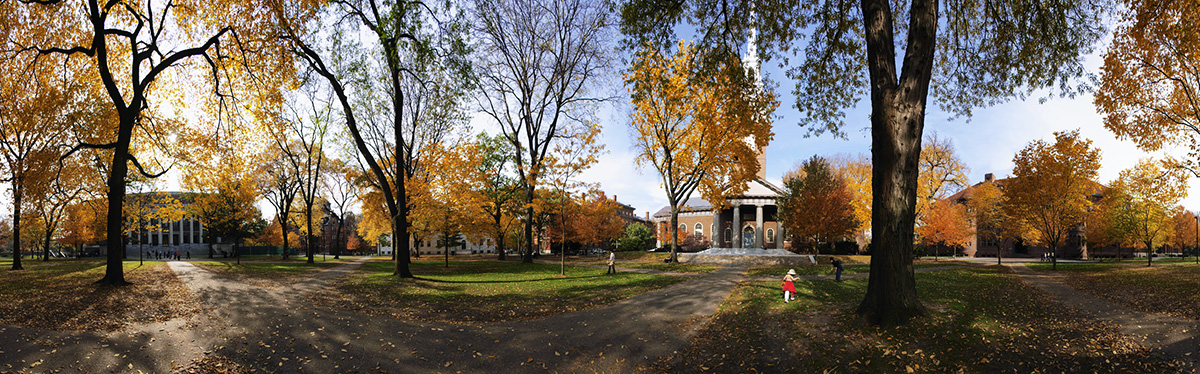
“This place is so much nicer without those banners,” a friend said the other day as we walked through the Law School yard, articulating something simple but insightful about Harvard. When graduation rolls around, every yard around campus undergoes a sudden makeover. Tailored by teams of landscapers and decked out in tents and stages and banners, they become the centerpieces of the school’s famed pomp and circumstance, the sacrosanct, stately grounds of the old academy where Latinate phrases and laminate cards, heartfelt hugs and Kleenex, and clicking cameras abound. Of course, the glut of decoration aside, the scenes those cameras capture seem more real, painfully, bittersweetly real, than anything else that happens at Harvard. But what those graduation photos miss is a piece of reality underneath it all, the beautiful truth of Harvard beneath all the chairs and the caps and gowns and the crimson: the open spaces themselves.

Like anyone else who’s ever come to Harvard, the Yard was firmly planted in my brain as the sole symbol of the school long before I had even stepped foot in Memorial Hall, or knew about The Crimson, or what HUPD stood for, or how to get inside Widener, or where Hollis was (still not sure of that). My earliest memories of the Yard jibe with the way I sometimes see it in old woodcuts: quiet, orderly, stately in its serenity—with the modern addition of the tourists who come to admire the red brick and gather around John Harvard’s foot. I bet this official version of the Yard is the one that sticks in the minds of most visitors. But it’s not the version of the Yard I’ll remember.

I prefer the Yard where one night freshman year some friends and I began a makeshift Primal Scream, half-naked, more drunk on life than on someone’s moonshine, gleefully befriending everyone we traipsed past; the one where earlier this year I and others made fruit juice atop a wooden press that my friend had constructed beneath the oak trees; the Yard where one night this year a dance party paraded, fueled by hundreds of portable radios; or the Yard through which a ragtag bunch marched with a bizarre, colorful, 10-foot fabric cube in the first snowfall of the year—for no good reason, but for every great reason.

So it went for most open spaces at the college. Any time the weather would allow, and even sometimes not, we transformed our yards. Whether it was sharing poems and bread under the crabapple trees near Houghton library or having a picnic in Quincy courtyard or stretching out at the Business School or gathering in the Sunken Garden at Radcliffe, 50 strong, armed with makeshift instruments, art supplies and bottles of wine, reveling in the spring grass and the serendipitous sprinklers, my friends and I managed to forge our own little commencement events where frivolity replaced ceremony. These yards, where we’ve lounged or played ball, or caught a precious glimpse of nature, are just as much, if not more, a part of Harvard than the libraries, the dorms, and the classrooms.

I’m not sure exactly what draws us to the Yard—by which I mean all yards: perhaps it’s a craving for our own temporary Waldens, or perhaps it’s just our need for communal space (something the College otherwise sorely lacks). Whatever it is, I’ve come to appreciate the place of the Yard in Harvard’s mythos. Combining secluded tranquility with a sense of openness and accessibility, the Yard aptly signifies the central paradox of the public-minded university. If ivy-covered walls forbid the curious from peeking in on the cloistered life of the academy, open gates and sumptuous lawns beckon with a spirit of public generosity.

Meandering between the undeniable exclusivity of our Harvard experience and our necessary places in the outside world, we stand at this divide whether we like it or not. As we prepare to make the leap from one side of the gates to the other, the message left for us on one of those gates by a much older class of Harvard sharpens the difference between where we are and where we’re going: “Enter to Grow in Wisdom,” commands the entrance, and “Depart to Serve Better Thy Country and Thy Kind,” says the exit. But don’t we already strive to do both at once? Aren’t the boundaries of the Yard—the space and the College itself—more porous than ever before? Indeed, is that old motto, explicating the separation between Harvard and the world, any more necessary nowadays than the old gate and the wall on which it’s written?

Despite Harvard’s emphasis on open space—arguably the signature element of the campus—walls tend to crop up around here, not only outside the College but within it as well. If they aren’t made of brick, the walls are more insidious, held up by elitism, prejudice, or just plain reluctance. While most groups are open to anyone on campus, sometimes they can become overly self-selective. The sad result can be a set of firm boundaries with little interaction between people that might have interests in common. Meanwhile, final clubs and art groups tend to restrict their membership along lines that often seem arbitrary, turning community- and art-making into a competitive social sport. But campus groups and Harvard itself need not give up their high standards to give up elitism or unnecessary selectivity. All we need to do is consider how high our standards can go without a good dose of openness—open-mindedness, accessibility, and inclusion of others not like us.

We need even more healthy open spaces, literally and figuratively. The former may be coming in the form of Harvard’s Allston campus, for which planners have promised to turn unused asphalt lots into green spaces, while ensuring that new buildings are environmentally friendly. But keeping Harvard’s figurative spaces open requires attention too. Some years back the real estate office published an obsessively researched tome called “Harvard Patterns,” which refers to the Yard’s “loose geometrical rigor,” and deduces that the “movement between spaces rarely occurs on-axis, but instead requires a shift onto a sub-axis, which itself usually organizes a subsidiary space in the composition.” In other words, moving through Harvard’s fluid open spaces leads to even more open spaces. We don’t need geometry to know that this is the way the Yard was designed and the way that Harvard and the world on the whole operates best: open to new ideas, people, places, and new ways of seeing the same old thing. The spaces we pass through in our caps and gowns have been transformed, but not for good. Only Harvard students can really transform them.

Tuesday, December 07, 2004

An Opt-Out Wind Energy Fee


Last year, a group of students at Harvard’s Kennedy School got wind of what millions of students, consumers, businesses, governments and various organizations had been doing for years: paying a little extra money to get some clean, renewable energy. They lobbied the student government and the administration and encouraged their peers to vote on a referendum that would add a small fee to students’ term bills. The reasons for doing so were clear enough to the majority of the school’s public policy students: the planet’s energy supply, weakened by the bombing of oil pipelines and the explosive jitters of investors, seemed as unstable as the planet’s environment and health. Today, all of the Kennedy School’s energy comes from the wind.

This week, Harvard undergraduates have an opportunity that students at hundreds of schools, including the Kennedy School, Duke, the University of North Carolina and the University of Pennsylvania, have already taken: the chance to bring healthy, clean renewable energy to the College.

At particular issue is whether a $10 fee to pay the premium for such energy—mandatory or optional—should be placed on students’ term bills, and whether, if optional, such a fee should be one that students pay only by checking a box on their bill (“opt-in”), or pay by default with the opportunity not to pay, again by checking a box (“opt-out”).

Of course, some wonder why students, and not Harvard, should foot the bill for renewable energy. The answer is two-fold. First, the administration isn’t prepared to do so at this point, so it’s up to the students to get started, with the expectation that the administration will recognize how important this is to students. Second, we students are the ones using energy in the dorms, the ones whose energy use impacts the environment for better or worse. An optional fee isn’t a burden on students, but an opportunity.

If you’re in support of optional renewable energy, an “opt-out” fee is superior to an “opt-in” fee: it avoids the problem of having to “revote” when you (or your parents) pay the term bill, and it ensures that enough money will be secured for a renewable energy purchase even if people forget to tick a box on their term bill. Since students, and not parents, are the ones using energy in the dorms, making the fee “opt-out” will extend the power of students’ decision from the ballot to the term bill, while still allowing for the veto power of students and parents at the time of payment.

The money collected would be handled by a new committee of students and faculty who will be dedicated to making the best purchasing decision at the time and to deciding what portion of the money, if any, should go toward on-campus renewable energy projects. The idea comes with the endorsement of a bevy of student groups, including this newspaper, and all of the candidates for Undergraduate Council president. And a little over a year ago, when undergraduates were polled about paying an extra $25 per year for renewable energy, 69 percent of respondents said they would (17 percent said they weren’t sure). Those results and a wealth of other information can be found at www.greencrimson.com/energy.

Currently, each Harvard undergrad produces roughly 3,340 lbs. of pollutants per year; if each student were to pay $10 to purchase 25 percent of our dorms’ energy from a regional wind farm, the improvement would be equivalent to taking 2,200 cars off the road every year, or planting 260,000 trees.

At a time when the school’s greenhouse gas emissions have increased by 40 percent over the past 12 years, a vote for a small optional renewable energy fee offers us Harvard students the opportunity to play a greater role in an environment each of us already affect. Think of a fee as paying a premium cost for a better product, or investing in an economically and politically stable resource that will lead to a healthier environment, all at the cost of a movie ticket. Ben Affleck movies never looked so bad.

The reasons for paying an extra $10 are blowing in the wind. Today scientists—most recently an eight nation group called the Arctic Climate Impact Assessment—mostly agree that the release of carbon dioxide and other pollutants into the atmosphere has caused a greenhouse effect like never before, resulting in not only increased temperatures, but also in increased frequency of extreme weather events, such as floods and droughts.

But whether or not one believes that our current energy supply is detrimental to the weather, the effects of burning coal and oil are felt at home, and in our lungs, every day. The stuff that comes out of power plant smokestacks has contributed to make asthma one of the fastest growing childhood ailments in industrial and developing countries alike, and has also recently been linked to lung cancer. Here in Massachusetts, where five power plants burn thousands of tons of coal every year, the effects on surrounding communities are significant. A 2000 study by the Harvard School of Public Health Professors Jack Spengler and Jonathan Levy concluded that two local coal-fired power plants, one in Salem and one in Somerset, led directly to a combined 1,710 emergency room visits, 43,300 asthma attacks, and 298,000 daily incidents of upper respiratory symptoms per year.

Harvard’s purchase of wind energy will not only fuel interest in renewable energy by invigorating its ever-growing market, thus making coal plants increasingly obsolete: a purchase will also send a strong message that the thoughtful, intelligent students of the best school in the world understand and care about the impact we as Harvard students have on the local and global environments about which we spend our days learning.

Importantly, that influential message will be felt not just far and wide, but around the Yard—to the administrators and trustees who decide how to lead Harvard—and to the current and future students—who decide how to lead the world.

We think a small step like this is commensurate with the kind of world-shaping Harvard students hope to do when they leave the gates: that is, work not just for oneself, or for a particular cause, or even for one’s school, but for the greater good—to actually make a world of difference.

Alex L. Pasternack ’05 is a history and literature concentrator in Winthrop House, and is also a Crimson editor. Matthew W. Mahan ’05 is a social studies concentrator in Kirkland House. He is also the president of the Undergraduate Council.

Friday, November 19, 2004

Sufjan Stevens Profile


Published on Friday, November 19, 2004
Biblically minded folkie shares faith in song—just don’t call it Christian rock


Crimson Staff Writer Even if your only religion involves band t-shirts and b-side vinyl, consider for a moment an afternoon organ recital at your local cathedral as a perfect, albeit unlikely, refuge from today’s folk-pop play list: a salvation, if not from evil, then from present day independent music’s fuzzy instruments, vague lyrics and disaffected warbles, so often praised by the disaffected critics at that God of indie webzines, known, perhaps fittingly, as Pitchforkmedia.com.

Listening to Sufjan Stevens, 29-year-old songwriter and rising folk darling (even Pitchfork loves him), is one such sanctuary, a slightly dark, unabashedly earnest and hopeful experience. With the delicate voice of a young man who’s just losing his world-weary reticence, Sufjan (pronounced SOOF-yan), whether in conversation or in song, perpetually sounds as if he’s making his transcendent re-entrance to a simpler place with a sweet, happy calmness.

If the sight of the cherub-faced troubadour serenely strumming alongside his troupe of happy horn players, bell-ringers and la-la-laaing singers (all of them friends, and all of them shockingly gorgeous) isn’t one of the most convincing displays of transcendence-by-banjo, just check out the congregation. At the Middle East club last Sunday, there was none of that self-conscious swaying-and-chanting stuff, but there was ample staring and a lot of smiling. The cynical, pierced ears of all the emo kids were melting.

That feat is even more impressive considering his favorite topics of late. First, there is his home state of Michigan, to which his 2003 album Greetings from Michigan: The Great Lakes State is a tribute (he has a plan to do the other 49 too, and will continue with Illinois—“I’ve been reading a lot about Lincoln, poetry by Carl Sandberg, doing research,” he says). And then there’s his other favorite topic: his Father.

Yep, that Father.

You can call Sufjan good—he is very, very good, in a few senses of the word—but don’t call him a Christian musician. “My music is just about story telling,” he offers. “I don’t have much to say, and I’m not trying to change anyone’s mind.” On the phone from California, where he’s rehearsing for indie-rock’s prestigious All Tomorrow’s Parties festival, Sufjan sounds just as polite and delicate as he does on record. “I’m just singing through conviction about what I love and what I care about, starting with the very small.”

Sufjan’s interest in the small carries over into a perfectionist precision in his music and voice. His poetry grows universal through its vivid specificity and his concerns, whether bathed in joy or pathos, are important to us because every syllable and every note is important to him, a result of years pouring over the ornaments of Bach, the flourishes of Debussey, and the complexities of Philip Glass—“Although I’m not going to pretend I’m on that level of sophistication.”

But both technically and emotionally, it’s hard not to be love-struck by the dancing patterns, shimmering percussive explosions and pin-pricked arpeggios that animate his vivid meditations, which may be on fraying familial relationships, the unemployed of Flint, Michigan, or, to take an example from his latest album, the story of Abraham.

Of course, singing about things like that in the world of popular music verges on the sacrilegious. Despite being the bedrock for much of our civilization’s greatest artists, from Michelangelo to Joyce, God hasn’t fared too well on stereos in recent decades. Like protest or political anthems, “praise” songs are relegated to the farthest possible margins of coolness, not just because of their pedantic (and un-cosmopolitan) message, but because their preaching and passion doesn’t make for very good music. In the case of the ever-demonized field of Christian rock, top-40-hood isn’t totally out of the question—that is, until listeners realize what over-the-top trash they’re singing along to.

There are of course notable exceptions: Kanye West has brought God back to mainstream rap (“Well if this take away from my spins / which will probably take away from my ends / then I hope it take away from my sins” is his approach to the popular/religious music divide) while good singer-songwriters like Joseph Arthur and Pedro the Lion have been doing the same in indie music. If the folk and emo sensibilities of rap and indie-pop make these genres friendlier to religion than usual, these genres also tend to be more self-conscious, making the music itself better but making the audience harder to please at the same time.

If Sufjan is pleasing them it is not just despite of, but also because of his particular spin on praising the Lord. While his Christian leanings remained largely invisible for last year’s folk-rock revelation, Greetings from Michigan, they aren’t hiding at all on his newest and just-as-lovely record, Seven Swans. But forget the apparent flag-waving of titles like “Abraham,” or “The Transfiguration” or “In the Devil’s Territory;” Sufjan never eats the apple of triteness, excess, or pedantry. He always dignifies his audience and his subject matter by directing his adoration into an occasionally unearthly music that nonetheless never leaves human ground, never falling into the preachy.

This is how Sufjan can get even the most secular of listeners not only to appreciate his tributes to his One Love but also to partake in their beauty too. In the album’s title song, when he sings, atop a melodious mountain of voices and bells and old piano, “He will take you / If you run / He will chase you / ’Cause he is the Lord!” his most potentially melodramatic moment becomes his most transporting.

Among his audience, it is debatable whether beautiful love songs like “To Be Alone With You,” which could as easily be addressed to a “she” as to a “He,” deserve to be pigeonholed as “Christian music” at all. Sufjan certainly doesn’t think so. His only interest is making songs about his own private love, and hopes that people can remember to love, something, anyone, in the midst of a troubled world.

Speaking of which—and considering his obsessions with the fifty states and God Himself—not asking Sufjan about America’s peculiar mixture of religion and politics is like not asking John Kerry if he supported the war in Iraq.

“Christianity is a faith that has no interest in power or no meaning in an environment of power or wealth,” he explains, his lilt turning slightly urgent but remaining delicate. “The moral imperative is a delusion, and [in terms of the election] I think it’s a distraction; [Christianity] is not a faith of morals or principles; it’s about a relationship, service in love to God and other people. If it were about morals and virtues, I don’t think Jesus would have pissed off so many Jews; he was doing things that were considered obscene. He was doing work on the Sabbath, he was a messy angry person. He definitely wasn’t guided by principles.”

Sufjan’s religious upbringing, he says, was a mix of untraditional Midwestern beliefs encouraged by his hippie parents: “Amway, self-realization training, methods camp, Catholic school, macrobiotic diets, yoga—we jumped from thing to thing.” He landed on protestant Christianity because he found it grounding, “so simple and stable.”

What he sees in the Christianity of “red state” American politics however, of the moral standards of “the religious right” and the Christian Coalition, is something else entirely, amounting to nothing more than “a political lobbying group.”

“Morals, principles and laws are when faith is reduced to standards and those standards basically just bind us, and we become prejudicial, racist, self-serving when we’re guided by these laws... When a developed country uses Christianity in its policies, in government, in maintaining corporate wealth, that’s a bastardized rendering of a faith.”

For his part, Sufjan is keeping the faith by remaining faithful to the music he’s been making since the oboe in middle school, since the dog days of “Readers Digest renderings of famous classical works.” If he’s not writing arrangements for his new album on the piano, he’s tuning his banjo or tapping a beat on the computer, an instrument he learned could be “really musical.” Evidence can be found on his electro-acoustic opus, “Enjoy Your Rabbit,” which he recorded while getting his masters in writing at the New School of Social Research in New York. And like most artists who live in Brooklyn, he practices freelance graphic design on the side.

And then there’s Sufjan’s new record label, called Asthmatic Kitty. While he’s doing “a lot right now” for the label, he’s definitely looking forward to doing less organizational work and more finding new bands with his friends. “It’s not quite a cooperative situation, but everyone has a certain stock in the label. It’s a very social thing.”

The social aspect is part of his whole vision too, what gives his music humanity—and humaneness. Despite the size of his ideas or his concerns or his devotion, Sufjan always wanders back to the local level.

“This election was about big issues which have no impact on our day-to-day lives,” he says on Nov. 5, “but we’re about the small things. We should care about caring for each other; TV is ruining us; sometimes I get depressed and feel like this is the decline of civilization. Politicians aren’t interested in what the people want: they’re interested in their careers.”

Even though Sufjan’s own career is pretty well established, you’d be hard pressed to say that’s all he was interested in, if he is at all. “If there’s anything to say, if there’s anything to do,” he sings on the Michigan album, “If there’s any other way, I’ll do anything for you.” His real interest is in what his God wants, and what a lot of people in Michigan and all the other states want too: some beautiful home-grown harmonious love.

—Staff writer Alex L. Pasternack can be reached at apastern@fas.harvard.edu.

Monday, November 01, 2004

Matt and Ben at Winthrop House (my house!)

Originally published on Monday, November 01, 2004 in the News section of The Harvard Crimson.


Theater Review: Dynamic Duo Humors with Past
By ALEXANDER L. PASTERNACK
On Theater


Writing a hit script is about as hard as finding a parking space in the Square (or so goes one playwright’s saying, I think). When the producers of the hit play Matt and Ben couldn’t find a venue in the area that would suit their playful fiction-based-on-fact one-act about the younger travails of Messrs. Damon and Affleck, they opted for a space as unlikely, and as good, as any: the Winthrop House Junior Common Room. This is where, Harvardwood lore has it, the illustrious Mr. Damon emoted his last emotion as a babyfaced undergrad actor, just before leaving to begin a now fabled campaign to write and sell Good Will Hunting, a script he began in an English department playwriting class (reportedly).
That stage (which is actually a temporary assemblage of whatever plywood happens to be on hand), and its set, a straightforward gathering of dorm room furniture and the staple Red Sox banners and Rock Bottom beer handles, may be the only piece of vérité (or Veritas, if you will) the play has in common with its historical inspiration: how in 1995, the Harvard perfectionist and his fun-loving high school buddy wrote the screenplay that launched a thousand People magazine covers. Indeed, the folklore that surrounds these two Cantabridgians is the subtext for Matt and Ben, which, with a bevy of gossipy pop-cultured winks, doesn’t even aim for accuracy. One of the play’s biggest jokes is clear as soon as the lights go up: not only do the actors bear no resemblance to their real-life counterparts, but neither are men, and the one playing Ben Affleck is black. If we did not know this trick ahead of time, not even the J.Lo-Affleck phenomenon commonly known as Bennifer (defined at urbandictionary.com as “A horrible combination that may ultimately bring about the apocalypse”) could prepare us for this surprise.

In any other play, this conceit could be part of the message that our beloved famous people aren’t actually who they appear to be, or something about identity construction etc., but fortunately Matt and Ben has lighter interests. In a turn of meta-theatrical cheekiness—and out of economic necessity—playwrights and Dartmouth grads Mindy Kaling and Brenda Withers took up the acting ropes when the play first opened at P.S. 122 in New York, to rave reviews that culminated in top honors at the city’s Fringe Festival in 2002. The actor-character gimmick, embodied in the current production by the very talented Quincy Tyler Bernstine as Ben and Jennifer R. Morris as Matt, might have more to say about how scripts are turned into full-on productions, or how stars are born, than anything else. As the play tells us, accurately I should add, the real Matt and Ben demanded that their movie would not be made unless they had featured roles in it.

The single-minded drive of these two characters is evident from the start, as they flounder around Ben’s Somerville apartment trying mindlessly to adapt J.D. Salinger’s A Catcher in the Rye for the big screen. Bernstine’s knuckleheaded take on Affleck as a needy and whiny dilettante who can’t get an audition, complements Morris’s nerdy portrayal of the bossy, perfectionist Damon, edging both into the pathetic—if only we can forget the Academy Award and subsequent millions of dollars. Thankfully, we can. That these wimpy characters are both totally absurd and credible is a testament to the comic virtuosity of the writers and actors, and the lively but un-adorned direction of David Warren. The performance plays on the audience’s pre-established relationship with the real life Matt and Ben, dropping references to their past, contemporary and future lives, while managing to suspend the disbelief that comes with watching their over-the-top stage versions (not to mention their real-life “versions”). The impersonations—including additional riotous send-ups of Salinger and Gwyneth Paltrow—rely only partly on an impressionistic array of Matt and Ben-esque gestures, mannerisms and speech rhythms: hence the characters’ delightful confusion over which is the highest form of flattery, “imitation” or “adaptation.”

The other big joke is also dropped on our heads, and on Ben’s coffee table, as the lights go up: the script for Good Will Hunting was not the product of late-night improv sessions but a gift from the heavens. As much as this confirms our most delectable suspicion that even the real Matt and Ben can’t be for real (ok, I’m speaking for myself here), it is also the deus ex machina that sets in motion a test of friendship that jumps from one joke to the next, happily with little room for sentimentality.

Watching the two fret like babies over the script miracle is as funny as watching them fret like babies over who gets more credit, over whether Catcher in the Rye is a better idea, over whether to work together. The friendship’s defining moment is a talent show in high school (Cambridge’s Ringe and Latin) when Ben’s goofy dancing turns Matt’s serious Simon and Garfunkel rendition into a shtick. The incident defines the characters too, who haven’t much outlived that immaturity, and the play itself, whose humor could be likened to that of a very good TV sitcom: not brilliant, not incredibly sophisticated, but—considering the big gimmicks here, this is significant—not the kind that depends on cheap tricks either. And, Matt and Ben aside, perhaps the same should be said for the real Matt and Ben too.

But, then again, where’s the fun in that?

Saturday, October 30, 2004

Review: Hellboy, Special Edition DVD

The Harvard Crimson, October 29, 2004

Directed by Guilermo Del Toro

Columbia Pictures


If, to the purist, movie adaptations of novels are the equivalent of glorified book jackets, adaptations of comic books might be no-brainers: with the visuals already on paper, Hollywood writers and directors get to bypass the harder and, often, more imaginative steps of screen translation. But shortcutting is too often to the detriment of the films, not to mention unfair to their parent comics—the X-Men and Spiderman movies being among the rare exceptions. Hellboy, is another dark horse in this inked-up Hollywood universe, a steam-train of an adaptation that stays vividly faithful to the comic book engine underneath, even as it accommodates those whose only experience with a “graphic novel” film is Dangerous Liaisons.

The ways Hellboy manages to balance these audiences, like its special effects, are a sight to behold. Director and writer Guillermo Del Toro takes Mike Mignola’s cult-fave comic to new depths, adding meat to the hero and villains, expanding the back-story, and throwing in a crucial monster-human love story that the books lacked. But Del Toro’s adoration for the off-kilter miasma of Mignola’s world and the monster-fighting monster is also evident in his attention to the bizarre detail and playful spirit of the comic.

Everything from the gothic scenery to the story’s vaudevillian tone seeps through Guillermo Navarro’s vibrant photography and Del Toro’s script, as full of thrills as it is of an anti-formulaic, self-aware logic. Ron Perlman, of TV’s Beauty and the Beast fame, has the chops (and the eyebrows and the jawbones) to deliver Hellboy’s throwaway one-liners and punches with the appropriate devil-may-care élan: he’s Dirty Harry with a penchant for beer and pancakes, a superhero-everyman less detached than Batman and much cooler than Spiderman.

And, with a bad temper, a troubled relationship with a sultry firestarter (Selma Blair), and dark beginnings (some Nazis and Rasputin—stay with me here—invited him over from Hell through an inter-dimensional portal, before he was raised by the U.S. government), he makes Superman look like Al Gore. If that makes the tempestuous and down-to-earth Hellboy a more popular superhero version of our president, well, some may not argue with that. (Just as an FBI agent wonders if “we should go back and request a special permit, type 2—,” Hellboy punches through the brick wall. BRRRAM! “You guys comin’ or what?” he asks with a wink.)

Considering Del Toro’s deft exposition of the backstory, deepening Hellboy’s craggy recesses is probably unnecessary; but, in an era when films are shot with the DVD in mind, necessity takes a back-seat to the three disc special edition, complete with collector’s booklet of arcane diagrams and vulgar Latin. Character bios, conceptual art and hours of behind-the-scenes commentary abound; one feature even allows the viewer to jump from the movie into comic book expositions at crucial moments. The trigger-happy viewer will quickly dissolve into Hellboy nerd-dom, muttering “I did not know that” as he is apprised of the items on Hellboy’s utility belt.

While such extras may verge on the excessive, having background footage and extra features is far nicer than just silly screen-saver animations, especially when DVDs have so much space for extras anyway, and when the films themselves are as fun as Hellboy. Only a few recent DVDs, including the special editions of the Lord of the Rings trilogy, can, with justification, rival Hellboy’s encyclopedic treatment of the imaginaries and pools of ink that gave rise to its film version. Of course, only the devil knows what kind of tome we’ll get after the inevitable Hellboy sequels.

—Alex L. Pasternack

Friday, October 22, 2004

Sounds of Silence: New albums that know when to shut up

Review: Adem, Homesongs, and Kings of Convenience, Riot on an Empty Street

Harvard Independent, October 21, 2004

By Alex Pasternack

These days it’s hard to find records, even “folk” ones, that aren’t laced up with some slick production team, some ambient hum, or even the thick click of a drum machine somewhere in the background, lest there be a moment of silence. The slight twinkle that opens Adem Ilhan’s debut, Homesongs, could easily signal another attempt at folk-tronica, but it’s actually a sendoff. As his wistful, distortionless voice and guitar spread over the song, accompanied by a rattling autoharp, Mr. Ilhan reveals the song’s most important feature: a ponderous quiet. “Let this be a moment that you won’t forget,” he sings delicately.

This is no minor feat, but it seems even grander, in its own understated way, after a glance at his resume. Since high school he’s been the bassist and guitarist for a post-rock outfit called Fridge, which weaned him on the 1s and 0s, bleeps and pedals that bandmate Kieran Hebden skillfully wields in his own electronic solo act as Four Tet.

Instead of relying on laptop accoutrements however, Mr. Ilhan determinedly stuck with his trusty six-string and, over a few years of bedroom recording sessions, discovered he had another old-fashioned instrument lying around: a dark, personable tenor that can ably wind through hymns (“Long Drive Home”) and unlikely pop songs (“These Are Your Friends”), without losing its valuable sense of wobbliness, an uncertainty that floats between desperation and distance. When he sings, almost moaning, “It’s alright, everything will be alright,” on “Gone Away,” he is talking to himself as much as to a former lover.

But his intimacy doesn’t prevent an occasional intensity, appearing in the album’s warmer, more symphonic moments and pieced together from instruments exotic and accidental. Amidst the lonesome harmony of glockenspiel or harmonium, Adem allows the spindly rattle of guitar strings, the sound of lips opening and the sprinkle of indistinct background noises to spill in, creating a soundscape that is sparse but still expansive and inviting. That combination is fitting for an album of heartsick lost-love letters that relish the quiet of loneliness while still reaching out to the listener with compassion. “There will always be room at my table for you,” is his last beautiful refrain.

The divide between happy isolation and lovelorn wistfulness also drives a set of even quieter ballads on Riot on an Empty Street, the new album by the Norwegian duo of Erlend Oye and Eirik Glambek Boe, who go by the moniker Kings of Convenience. While the disquiet of that title—and that of their debut, Quiet is the New Loud, and Mr. Oye’s solo album, Unrest—is hardly evident in the Kings’ placid tenors, their lyrics capture the contradiction of moving forward while looking back. “Stay out of trouble, stay in touch / Try not to think about me too much,” is their mantra on one song, sounding as effortless as it is heartbreaking.

As with their lyricism, the Kings are firmly stuck in the past, not so much the founders of a “New Acoustic movement,” as the British press once dubbed it, as they are the inheritors of a pop-folk crown. Alongside lonely British troubadours like Damien Gough (Badly Drawn Boy) and Andy Votel, the Kings hardly stray far from the meandering footsteps of Elliot Smith, Nick Drake, and especially Simon and Garfunkel. But unlike their 60’s counterparts (of whom they do as impressive an imitation in their harmonies as on their cover photography), the Kings don’t want to be alone. On both Kings covers, a girl sits coyly in between them, a symbol of reticent sexuality that Simon and Garfunkel all but abandoned for the solitude of “I Am A Rock.”

The Kings attempt to step out of their progenitors’ shadow with the cutesy, upbeat, “I’d Rather Dance With You,” won’t rouse many listeners out of their hammocks. But the bossa-nova experiments on some songs (the guitar and trombone song “Live Long,” and the lovely, piano-sprinkled “Misread”) along with the introduction of a female vocalist, the tidal-voiced Leslie Feist, signals a still-growing, promising sound, with a lyricism less cloying and twee than before. Any lingering doubts about their preciousness are washed away in “Gold in the Air of Summer,” the Kings’ best song to date, in which guitar, piano and an effulgent, swelling trombone give way to a hard-won but decisive dismissal of what’s come before: “I’ve brought everything we need/ don’t look back, don’t think of the/ other places you should have been/ It’s a good thing you came along with me.” Yes, it is.

Thursday, September 30, 2004

I Don’t Heart Huckabees

Review: I Heart Huckabees, opens October 1
Appeared in The Harvard Independent

There’s a lot of sizing-up staring in I Heart Huckabees. You know, a slightly turned head with narrow eyes looking warily at someone who, in this case, is usually doing likewise. The existential detectives Bernard and Vivian Jaffe (played exhaustively by Lily Tomlin and Dustin Hoffman) do it with a feverish intensity, perhaps because this is the only way they can size up their inscrutable subjects, like the protagonist and environmental activist Albert Markovski (Rushmore’s Jason Schwartzman). He is prone to fits of cosmic frustration over the true relevance of saving trees or how best to organize against the corporate conglomerate Huckabees, which is threatening to build on a precious swamp. But his real problem, naturally, is the gangly seven-foot Sudanese refugee he keeps encountering around town.

To the detectives, this is no mere coincidence. “Everything is connected and everything matters,” is Dustin Hoffman’s mantra, (or at other times, “everything is the same even if it’s different”, etc.) ideas he forces on his subjects through repetition, meditation sessions in a body bag, demonstrations with a white blanket. In writer-director David O. Russell’s logic, the sophistry is meant to be funny, but Mr. Hoffman’s quirky, happy-go-lucky idealism, like the nihilism of his sultry Sartreist archrival Caterine Vauban (Isabelle Huppert), manages to imbue them with some profundity too.

Russell has already proved capable of combining the heavy and light, the intelligent and the playful, to create films that fudge the line between surreal and documentary. 1996’s semi-slapstick Flirting with Disaster, which channeled Woody Allen through acid, is the finest and most thoughtful of those Ben Stiller “oh my god, why is this happening to me!?” movies. And then there’s Russell’s inspired and beautiful 1999 buddy action-comedy Three Kings turned the wasteland of post-Desert Storm Iraq into a fiery playground for meditations on American cultural influence, foreign policy, and an oil-seeped, image-driven war machine. Any questions about Russell’s commitment to the serious might be settled by his forthcoming documentary, Soldiers Pay, culled from a series of provocative interviews with American soldiers and some of the actors from Three Kings, who are actual Iraqi refugees.

Global concerns underlie I Heart Huckabees too: corporate conglomeration, the environment, personal responsibility, the aftermath of 9/11, marriage and family are all given shout-outs here. But amidst the film’s simultaneous spiritual obsessions and quirky situation comedy, shout-outs are all these topics get. Russell’s approach is surrealist, calling the viewer’s attention to unlikely combinations of thoughts and images that do not match and can just barely be sustained. But here the effect is only amusing for so long; unlike the Magritte painting that hangs in Albert’s office, the more you stare at the mix, the more exhausting it becomes. In the movie’s flawed surreality, hilarious one-liners, smart philosophical questions and powerful performances (especially from Jude Law and Naomi Watts, who play the golden boy Huckabees executive and his model girlfriend) might give us a refreshing Hollywood product, but they don’t add up to anything very emotional or intelligent. And in the case of a recent screening at the Museum of Fine Arts, they do add up to more than a few audience goers stumbling for the exit, a near-sacrilege at preview screenings, especially when the director and star are present (they were).

Decoding what a clever movie is trying to do and how it does it is always part of the fun, but with a movie only half-clever it’s more often a waste of time, a job we ought to leave to movie critics if they are so bored. My idea: the movie about the absurdity and enormity of life, but also about the absurdity of trying to make sense of that absurdity, and also about the absurdity of trying not to care about that absurdity too. With such scattered intent, scenes can be both protracted and empty, and the film isn’t quite sure not to know how to be serious when it is trying to be, or how to be very funny either. Ultimately, it feels like one of those overly drawn out jokes, almost funnier for its persistence and tedium than its content, and even then not that funny. The movie’s ultimate irony of course is that life itself is the joke, but that perhaps by telling the joke we can assert some order over life’s absurdity.

In a sense then, the movie operates the way some modernist poets wrote: in a world in which subjectivity is washed over by industrialization, corporations, and environmental destruction, the poem balances ideals with cynicism and, in so doing, leaves the audience both stunned and lost, searching for more personal meanings if any can be found at all. But it’s the postmodern influence—the non-reaction reaction to the hypnotic power of globalization and contemporary affairs, (a time in which “everything’s the same even if its different”)—that’s ultimately louder amidst all the philosophical bricolage and surrealist imagery. In the film’s self-canceling metaphysical calculus, the only thing lamentable about life is lament itself. The rest of living, like I Heart Huckabees, is a lot of confusion that, after we’re done staring at, trying to size up and figure out, we might simply, somehow, find a way to enjoy. Or at least ignore, and go back to our own more compelling, more surreal lives.